CMMC Is Here: Key Takeaways from Synagex Modern IT’s Webinar with MassMEP


Recently, Synagex Modern IT joined MassMEP for a webinar all about CMMC readiness and what manufacturers should really be paying attention to as implementation moves forward.
Synagex President John Sinopoli and Director of Information Security Cathy O. discussed the CMMC rollout timeline, common misconceptions, documentation requirements, security awareness training, and why cybersecurity readiness is becoming such an important part of doing business in the Defense Industrial Base.
Read on for some of the major topics covered during the webinar.
CMMC Implementation Timeline
So CMMC is now law (lucky you)... And so what that means now that it is law is that we're all playing a part in keeping the supply chain to the defense industrial base secure. So we are all now going to be holding each other accountable. –Cathy O.

One of the first topics discussed was the phased rollout of CMMC requirements.
Beginning November 10, 2025, applicable Department of Defense contracts may begin requiring Level 1 or Level 2 self-assessments. Over the following years, certification requirements will continue expanding until full implementation is reached.
Major takeaway? Organizations should not wait until compliance is required in a contract before starting preparation!
Common Misconceptions Around Scope

A lot of organizations assume CMMC only applies to systems directly handling CUI (Controlled Unclassified Information). In reality, the scope is much broader. During the webinar, Synagex explained that assessments may also include:
Employees
Facilities
External Service Providers
MSPs
Cloud providers
Security systems
Specialized equipment and IoT devices
Cathy described it like an onion: organizations need to understand and protect every layer.
Documentation Is One of the Biggest Gaps
As Cathy explained, many organizations focus only on the control descriptions in NIST 800-171 while overlooking the detailed assessment objectives outlined in NIST 800-171A. That distinction matters. Assessors are not simply checking whether security tools exist. They are looking for evidence that organizations can:
Define policies and procedures
Identify responsible users and systems
Document asset inventories
Create network diagrams
Build CUI data flow diagrams
Demonstrate shared responsibilities with providers
The more detail, the better. Your assessor will be very happy. –Cathy O.


As Cathy explained during the webinar, “the devil’s in the details.”
Good documentation helps organizations clearly tell the story of their environment during an assessment.
Understanding Roles, Access & Training
The webinar also emphasized the importance of understanding who has access to what within an organization. Different employees face different risks and privileged account users require additional protections
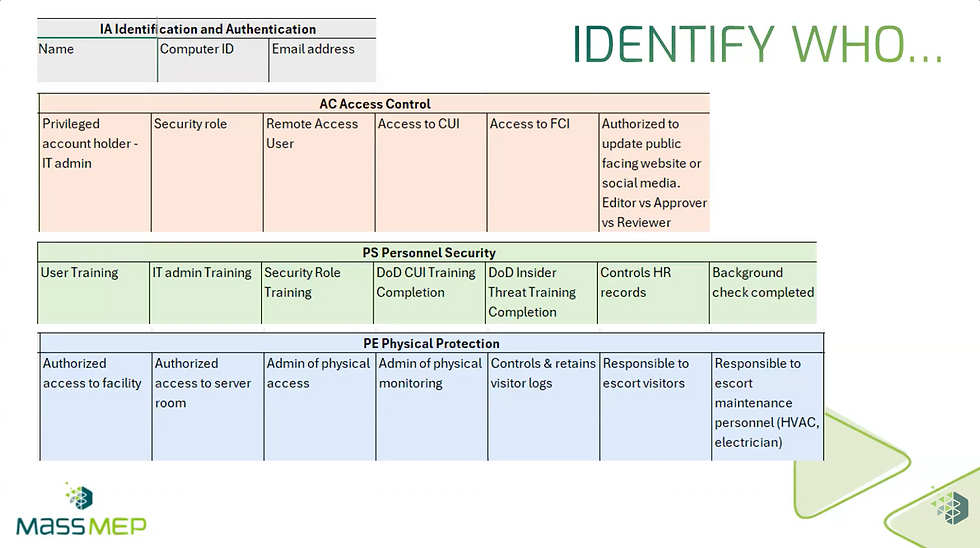
As always, strong security awareness training is essential, and training should be tailored to the responsibilities and access levels of different users. Because at the end of the day, cybersecurity is not just about tools. It’s about people too.
Visualizing Scope with Network & CUI Flow Diagrams
A powerful takeaway from the webinar was the importance of visual documentation.
Traditional network diagrams alone are not enough—Organizations should also maintain clear CUI data flow diagrams, segmentation diagrams, asset classification visuals, and boundary diagrams that help demonstrate how their environment is structured. These visuals allow assessors to quickly understand where CUI enters the environment, where it is stored or processed, how it moves internally between systems and users, and how external providers connect into the organization.

Organizations should aim to proactively “tell the story” of their environment rather than forcing assessors to piece it together themselves. Clear visuals simplify that process significantly!
You want to own that story. You tell the story. You want to paint the picture. You want to control the narrative during your assessment. –Cathy O.
The Bottom Line
CMMC can be complicated, but organizations don't need to navigate it alone. Preparing for compliance takes planning, documentation, awareness, and the right guidance. At Synagex Modern IT, we work with manufacturers to simplify the process, perform gap assessments, and help organizations build practical, achievable compliance roadmaps.
And if you want the full breakdown—including visuals, examples, and deeper explanations from Cathy and John—we highly recommend watching the entire webinar.
Because when it comes to CMMC readiness, understanding the details now can make a huge difference later. 😎

Comments