top of page
Search
  • Writer: Synagex Modern IT
    Synagex Modern IT
  • Jan 5
  • 2 min read

And yes… we’re all feeling it.


What AI Is Changing

AI hasn’t just made attackers smarter. It’s made them faster, more scalable, and more convincing. Cyber-attackers may already be using AI faster and more creatively than many defenders.We’re seeing:

  • AI-generated phishing emails that read like they were written by someone who knows you personally.

  • Deepfake voice and video scams that impersonate executives and trusted partners.

  • Malware that adapts based on how it’s being analyzed.

  • Automated reconnaissance that scans and maps targets in seconds.


The barrier to entry for cybercrime has dropped. You no longer need elite technical skills to launch sophisticated attacks. AI tools are doing the heavy lifting.

And for security teams? That means more alerts. More noise. More complexity.

It’s no wonder teams are tired.


At the same time, organizations are adopting AI-driven security tools of their own, which is great... but that also introduces a new risk: If you don’t fully understand the tools you deploy, attackers may find ways to manipulate or bypass them.

New technology can be powerful, folks, but it can also create new blind spots.


The Rise of Shadow AI

There’s another layer to this shift: Shadow AI.

Shadow AI happens when employees use AI tools at work that IT doesn’t know about. Personal ChatGPT accounts. Browser plug-ins. “Just testing something quickly.”


It feels harmless. But pasting company data into unapproved AI platforms can quietly leak sensitive information and create governance gaps your security team can’t see.

Recent industry reporting shows employee AI usage is moving faster than many organizations’ policies and oversight models can keep up.

Smart tools are great. Surprise tools? Not so much. Before using an AI tool for work, pause and ask: Is this approved?


So What’s the Strategy?

When AI accelerates threats, the instinct is to chase the newest defensive technology.

But there’s no “fence in a box.”There’s no single AI tool that magically solves AI threats.

Our advice is simple: Stay a little paranoid. 👀


Know your blind spots... Question assumptions... Test your defenses... Trust no one and no thing blindly... including your own tools!


New tech and AI can absolutely be powerful allies... but only when paired with:

  • Strong cybersecurity fundamentals

  • Clear governance and policy

  • Human oversight

  • Continuous monitoring

  • Ongoing employee awareness


The Basics Matter More Than Ever

AI didn’t replace cybersecurity fundamentals. It amplified the consequences of ignoring them. When the pace increases, discipline matters even more.


Strong hygiene still wins:

  • MFA everywhere possible

  • Patch management that actually happens

  • Identity and access controls

  • Tested backups

  • Network visibility

  • User awareness training

If attackers are moving faster, your foundation needs to be stronger.

Preparation compounds, but weakness compounds faster. 😬


The Bottom Line

AI can be your greatest ally or your newest risk. The difference is governance, oversight, and a security strategy built on people + process + tools.


Stay alert.Stay strategic.Stay just paranoid enough.

And as always—Keep IT Cool. 😎


Recently, Synagex Modern IT joined MassMEP for a webinar all about CMMC readiness and what manufacturers should really be paying attention to as implementation moves forward.


Synagex President John Sinopoli and Director of Information Security Cathy O. discussed the CMMC rollout timeline, common misconceptions, documentation requirements, security awareness training, and why cybersecurity readiness is becoming such an important part of doing business in the Defense Industrial Base.


Read on for some of the major topics covered during the webinar.


CMMC Implementation Timeline

So CMMC is now law (lucky you)... And so what that means now that it is law is that we're all playing a part in keeping the supply chain to the defense industrial base secure. So we are all now going to be holding each other accountable. –Cathy O.

One of the first topics discussed was the phased rollout of CMMC requirements.

Beginning November 10, 2025, applicable Department of Defense contracts may begin requiring Level 1 or Level 2 self-assessments. Over the following years, certification requirements will continue expanding until full implementation is reached.


Major takeaway? Organizations should not wait until compliance is required in a contract before starting preparation!


Common Misconceptions Around Scope


A lot of organizations assume CMMC only applies to systems directly handling CUI (Controlled Unclassified Information). In reality, the scope is much broader. During the webinar, Synagex explained that assessments may also include:

  • Employees

  • Facilities

  • External Service Providers

  • MSPs

  • Cloud providers

  • Security systems

  • Specialized equipment and IoT devices


Cathy described it like an onion: organizations need to understand and protect every layer.


Documentation Is One of the Biggest Gaps

As Cathy explained, many organizations focus only on the control descriptions in NIST 800-171 while overlooking the detailed assessment objectives outlined in NIST 800-171A. That distinction matters. Assessors are not simply checking whether security tools exist. They are looking for evidence that organizations can:


  • Define policies and procedures

  • Identify responsible users and systems

  • Document asset inventories

  • Create network diagrams

  • Build CUI data flow diagrams

  • Demonstrate shared responsibilities with providers


 The more detail, the better. Your assessor will be very happy. –Cathy O.


As Cathy explained during the webinar, “the devil’s in the details.”

Good documentation helps organizations clearly tell the story of their environment during an assessment.


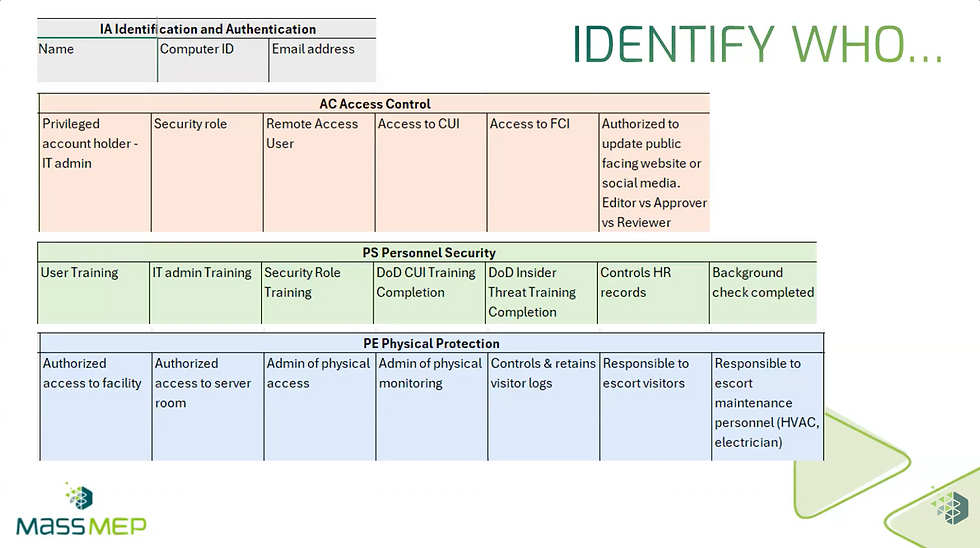
Understanding Roles, Access & Training

The webinar also emphasized the importance of understanding who has access to what within an organization. Different employees face different risks and privileged account users require additional protections


As always, strong security awareness training is essential, and training should be tailored to the responsibilities and access levels of different users. Because at the end of the day, cybersecurity is not just about tools. It’s about people too.


Visualizing Scope with Network & CUI Flow Diagrams

A powerful takeaway from the webinar was the importance of visual documentation.

Traditional network diagrams alone are not enough—Organizations should also maintain clear CUI data flow diagrams, segmentation diagrams, asset classification visuals, and boundary diagrams that help demonstrate how their environment is structured. These visuals allow assessors to quickly understand where CUI enters the environment, where it is stored or processed, how it moves internally between systems and users, and how external providers connect into the organization.


Organizations should aim to proactively “tell the story” of their environment rather than forcing assessors to piece it together themselves. Clear visuals simplify that process significantly!

You want to own that story. You tell the story. You want to paint the picture. You want to control the narrative during your assessment. –Cathy O.

The Bottom Line

CMMC can be complicated, but organizations don't need to navigate it alone. Preparing for compliance takes planning, documentation, awareness, and the right guidance. At Synagex Modern IT, we work with manufacturers to simplify the process, perform gap assessments, and help organizations build practical, achievable compliance roadmaps.


And if you want the full breakdown—including visuals, examples, and deeper explanations from Cathy and John—we highly recommend watching the entire webinar.


Because when it comes to CMMC readiness, understanding the details now can make a huge difference later. 😎


Today is Computer Security Day, a perfect reminder that staying secure doesn’t always require complex tools or big changes. Often, it’s the everyday habits that matter most.

Cyber threats continue to evolve, but one thing stays the same: people are still a critical line of defense. That’s why we believe cybersecurity awareness should be practical, approachable, and built into how we work every day.


To celebrate Computer Security Day, our team put together a short video featuring Pete, our Senior Cybersecurity Consultant, sharing some of his go-to tips for staying cyber-smart. These are simple actions anyone can take, whether you’re working in an office, at home, or somewhere in between.


1. Stay Alert to Phishing and Sketchy Websites

Phishing remains one of the most common ways attackers gain access. Emails, texts, or pop-ups that create urgency, ask for credentials, or look slightly “off” are worth slowing down for. When in doubt, don’t click—verify first.


2. Be Mindful of What You Share Online

Social media is a goldmine for attackers doing reconnaissance. Job titles, travel plans, workplace photos, and even casual posts can be used to craft more convincing scams. Share thoughtfully and keep privacy settings in check.


3. Practice Strong Password Hygiene

Strong, unique passwords for every account are essential. Using a password manager can make this easier and safer than trying to remember everything yourself. And yes, “password123” is still a hard no.


4. Lock Your Computer When You Step Away

This one sounds simple, but it’s often overlooked. Whether you’re in an office, a coffee shop, or at home, locking your screen when you walk away helps prevent unauthorized access and protects sensitive information.


Small Habits, Big Impact

None of these tips are groundbreaking, but together, they form a strong foundation for better security. Cybersecurity isn’t just about tools and technology; it’s about consistent, everyday actions that reduce risk. This Computer Security Day, we encourage you to take a few minutes to review your habits, watch the video, and make small improvements where you can. Awareness plus action is a powerful combination!


Stay vigilant, stay informed, and as always—Keep IT Cool. 😎🔐


Headquarters

703 West Housatonic St

Suite 108

Pittsfield, MA 01201

Colorado Service Branch

143 Union Blvd 

Suite 900 

Lakewood, CO 80228

Innovation Office

Berkshire Innovation Center

45 Woodlawn Ave

Pittsfield, MA 01201

What is Synagex?

Synagex Modern IT is a simple IT and cybersecurity solution for businesses. Synagex delivers the entire IT ecosystem and cybersecurity protection that every business needs and combines that with strategy to enable business growth. Synagex is also a Registered Provider Organization (RPO) providing CMMC assessments and extensive cybersecurity services. All Synagex services have the same guiding principle simplifying concept to service delivery.

RPO CYBER AB BADGE.png

Follow Us On:

  • LinkedIn
  • Facebook
  • Instagram

© 2023 by Synagex

bottom of page